
What is an LLM?
The Technology That Turned Language Into Infrastructure
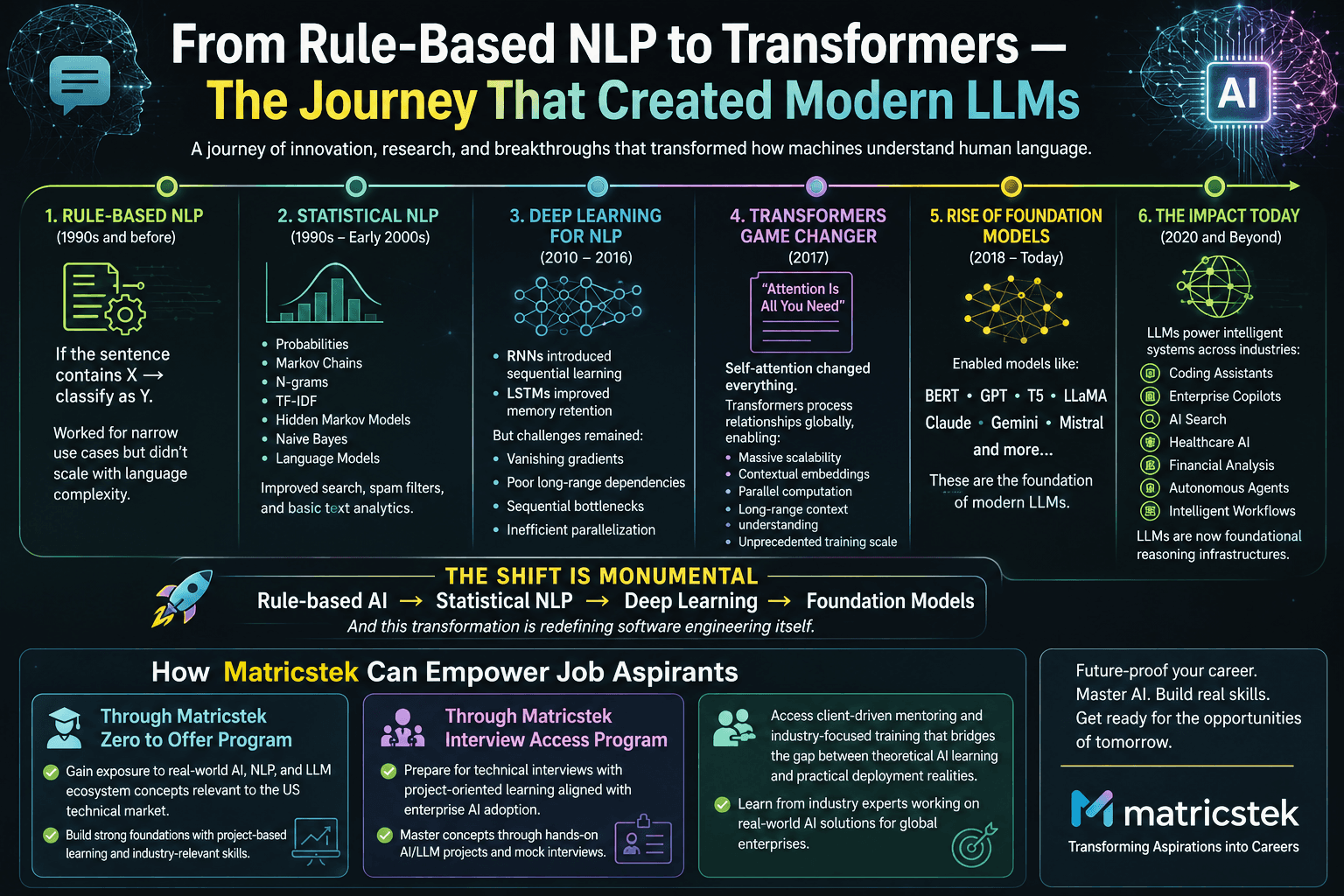
Most people think an LLM is just a smarter chatbot.
That definition is not wrong.
It is simply disastrously incomplete.
Calling an LLM a chatbot is like calling a data center “a room with computers.”
Technically true.Practically meaningless.
Because what we are witnessing is not merely a better conversational interface.
We are witnessing the emergence of systems capable of compressing vast portions of human linguistic patterns into mathematical representations and generating coherent reasoning-like behavior from them.
And that changes computing itself.
The Simplest Way to Understand an LLM
Imagine a child who has read:
billions of books,
millions of research papers,
endless code repositories,
legal contracts,
social media arguments,
Stack Overflow discussions,
scientific literature,
and half the internet.
Now imagine that child developing an extraordinary ability to predict:
“What is the most probable next word given all previous words?”
That is the foundational idea behind an LLM.
At its core, a Large Language Model is a probabilistic sequence prediction system.
Not consciousness.Not sentience.Not human reasoning.
Prediction at scale.
But scale changes everything.
The Core Idea: Tokens and Prediction
LLMs do not process text like humans.
They process tokens.
A token may be:
a word,
part of a word,
or even a symbol.
For example:
“Artificial Intelligence is fascinating”
might become:
["Artificial", "Intelligence", "is", "fascinating"]
or even smaller subword fragments depending on the tokenizer.
The model learns:
P(next token | previous tokens)
Meaning:
“What is the probability distribution of the next token given the context?”
If you think deeply about this, almost every language task becomes a variation of prediction:
question answering,
reasoning chains,
dialogue generation.
Everything becomes sequence modeling.
Why Earlier NLP Systems Struggled
Before transformers, NLP systems heavily relied on:
RNNs (Recurrent Neural Networks)
LSTMs (Long Short-Term Memory Networks)
GRUs (Gated Recurrent Units)
These models processed text sequentially.
One word at a time.
That created major bottlenecks:
poor long-range dependency handling,
vanishing gradients,
limited context retention,
slow training due to sequential computation.
For example:
In the sentence:
“The animal didn’t cross the road because it was too tired.”
Traditional models often struggled to understand what “it” referred to.
Context understanding was weak.
Then came the revolution.
Transformers Changed Everything
In 2017, the paper:
“Attention Is All You Need”
introduced the Transformer architecture.
This paper fundamentally changed AI.
The biggest innovation?
Self-Attention.
What is Attention?
Attention allows the model to determine:
“Which other words in the sentence are important while interpreting this word?”
For example:
“The bank near the river overflowed.”
vs
“I went to the bank for a loan.”
The word “bank” changes meaning based on surrounding context.
Attention mechanisms dynamically capture these contextual relationships.
This enabled:
contextual understanding,
semantic relationships,
parallel training,
long-context learning,
dramatically improved scalability.
Transformers stopped reading text like a chain.
They started analyzing relationships globally.
That was the turning point.
Embeddings: Turning Language Into Mathematics
LLMs cannot understand words directly.
They convert tokens into vectors.
These vectors are called embeddings.
An embedding is essentially a high-dimensional numerical representation of meaning.
Words with similar meanings tend to exist closer in vector space.
For example:
“king” and “queen”
“doctor” and “physician”
“Python” and “programming”
may exist in semantically related regions.
This is one of the most fascinating aspects of modern AI:
Language becomes geometry.
Meaning becomes distance in multidimensional space.
Parameters: The Statistical Memory of LLMs
People often hear statements like:
“This model has 70 billion parameters.”
What does that actually mean?
Parameters are the learned weights of the neural network.
They encode statistical relationships learned during training.
An LLM does NOT store facts like rows in a database.
Instead, it compresses patterns from enormous datasets into these parameters.
Think of it as:
compressed linguistic memory,
distributed pattern representation,
probabilistic abstraction.
That is why prompting matters so much.
You are not “fetching” answers.
You are navigating learned probability landscapes.
Why LLMs Feel Intelligent
One of the biggest misconceptions is:
“LLMs understand.”
Technically, they do not understand the way humans do.
Yet they exhibit emergent behavior.
Why?
Because:
language encodes reasoning patterns,
human logic exists within text,
code contains structured thought,
conversations contain causal relationships.
When trained at massive scale, models begin exhibiting:
reasoning-like behavior,
analogy formation,
instruction following,
tool usage,
code synthesis.
This phenomenon is often referred to as emergence.
Capabilities appear that were not explicitly programmed.
That surprised even researchers.
Why One Model Can Do So Many Tasks
Earlier AI systems were task-specific.
One model for:
another for sentiment analysis,
another for summarization.
LLMs changed this paradigm.
Because language became the universal interface.
The same foundation model can:
write Python,
generate SQL,
explain calculus,
summarize PDFs,
create business reports,
generate marketing copy,
analyze contracts,
answer questions,
assist in healthcare workflows.
This is why they are called Foundation Models.
They serve as the foundational layer for multiple downstream applications.
The Real Engineering Behind LLMs
Most people see only the chatbot interface.
But production-grade LLM systems are engineering ecosystems.
Training modern LLMs involves:
distributed GPU clusters,
tensor parallelism,
pipeline parallelism,
data parallelism,
mixed precision training,
gradient checkpointing,
massive token pipelines,
sophisticated optimizers,
trillion-token datasets.
Inference systems involve:
KV caching,
inference acceleration,
latency optimization,
GPU scheduling.
Enterprise AI systems additionally require:
vector databases,
RAG architectures,
fine tuning pipelines,
LoRA adapters,
prompt orchestration,
evaluation frameworks,
security layers,
hallucination mitigation.
This is why building enterprise AI systems is not merely:“Calling the OpenAI API.”
It is distributed systems engineering meets machine learning meets software architecture.
What is RAG and Why It Matters
One major limitation of LLMs:
They cannot reliably access fresh or proprietary information.
This led to Retrieval-Augmented Generation (RAG).
RAG combines:
Information retrieval
Vector search
LLM generation
The workflow:
documents are embedded,
stored in vector databases,
relevant chunks retrieved,
context injected into prompts,
model generates grounded responses.
This dramatically improves factual reliability.
Modern AI systems increasingly depend on RAG architectures.
Why Fine-Tuning Became Important
General-purpose LLMs are broad.
But enterprises often need specialization.
Examples:
healthcare terminology,
legal drafting,
financial analysis,
pharmaceutical workflows,
manufacturing documentation.
Fine-tuning adapts models to domain-specific behavior.
Modern approaches include:
LoRA (Low Rank Adaptation)
QLoRA
PEFT (Parameter Efficient Fine Tuning)
These methods reduce computational cost dramatically.
The Dark Side of LLMs
Despite all the hype, LLMs are far from perfect.
They:
hallucinate facts,
inherit biases from data,
struggle with deterministic reasoning,
consume enormous compute,
generate confident misinformation,
remain vulnerable to prompt injection,
lack true grounded understanding.
This is critical.
Because many organizations are deploying AI faster than they understand its limitations.
That is dangerous.
The Shift Happening in Software Engineering
Traditional programming looked like this:
Rules → Logic → Output
LLM-driven systems increasingly look like this:
Intent → Context → Prompt → Emergent Behavior
That is a tectonic architectural shift.
We are moving from deterministic software systems toward probabilistic software systems.
And this demands new engineering disciplines:
Prompt Engineering
AI Engineering
LLMOps
AI Safety
Model Evaluation
Retrieval Engineering
The Most Fascinating Part
For decades, humans adapted themselves to machines.
We learned:
programming languages,
command syntax,
operating systems,
query structures.
Now machines are learning human language.
That changes the interface layer of civilization itself.
Language is becoming programmable infrastructure.
And perhaps for the first time in computing history:
The barrier between human intent and machine execution is collapsing.
Final Thoughts
LLMs are not merely chatbots.
They are:
statistical reasoning engines,
language-based foundation models,
pattern compression systems,
probabilistic generators,
contextual intelligence architectures.
They represent one of the most important technological shifts of our generation.
But the future will not belong to people who blindly fear AI.Nor to those who blindly worship it.
It will belong to those who deeply understand:
what LLMs are,
how they work,
where they fail,
where they shine,
and how to integrate them responsibly into real-world systems.
Because this is no longer just AI research.
This is the beginning of a new computing paradigm.