
How Cloud Computing is Transforming Disaster Recovery (And Why It Matters for Your Career in the USA)
In today�s digital-first world, downtime is not just an inconvenience�it�s a direct business risk.
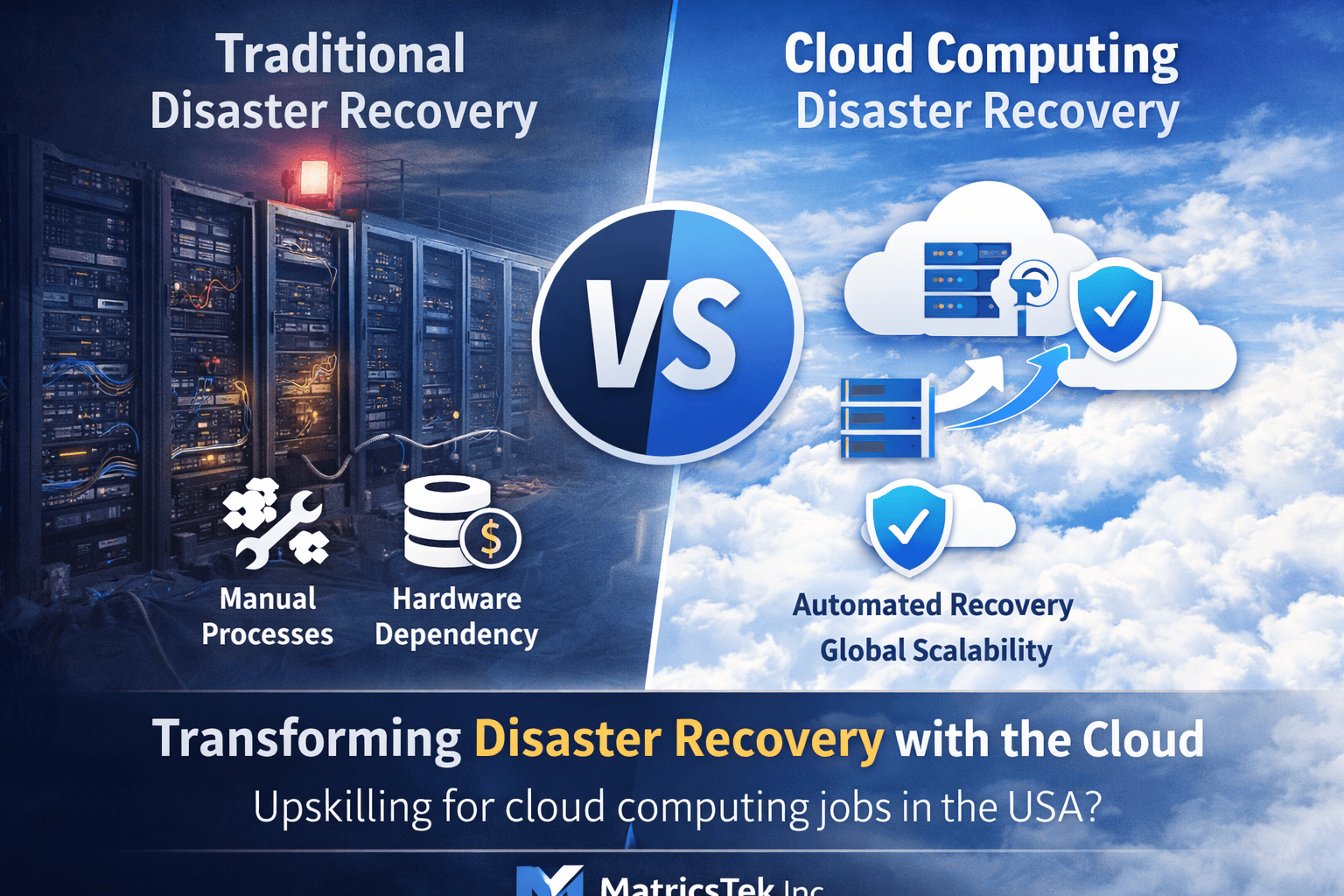
From financial services to healthcare to e-commerce, organizations are expected to operate with near-zero downtime, even in the face of unexpected disruptions. This is where cloud computing has fundamentally transformed disaster recovery strategies.
But here�s the shift most professionals miss:
?? Disaster Recovery is no longer just an IT responsibility.
?? It is now a core skillset for modern tech professionals, especially those targeting cloud computing jobs in the USA.
At MatricsTek Inc., we see a growing gap between what candidates learn and what the industry actually expects. This blog bridges that gap�technically, practically, and strategically.
________________________________________
?? Traditional Disaster Recovery: The Legacy Approach
Before the rise of cloud computing, disaster recovery relied heavily on on-premises infrastructure.
Typical characteristics included:
� Manual backup processes
� Physical data centers with limited redundancy
� High capital expenditure (CapEx)
� Long recovery times (RTO) and potential data loss (RPO)
� Dependency on internal IT teams for every recovery step
While these systems worked in the past, they struggle to meet today�s expectations of speed, scalability, and resilience.
________________________________________
?? Cloud Computing: A Paradigm Shift in Disaster Recovery
Cloud computing has redefined disaster recovery from a reactive process to a proactive, automated, and resilient system design.
Let�s break down how:
________________________________________
?? 1. Automation & Reliability: From Manual Recovery to Self-Healing Systems
In traditional environments, disaster recovery often involves manual intervention, increasing the risk of human error.
With cloud computing platforms like AWS (Amazon Web Services):
� Automated backups and snapshots are standard
� Failover mechanisms trigger automatically
� Infrastructure can be recreated using Infrastructure as Code (IaC)
?? Result: Faster recovery, reduced errors, and higher reliability
________________________________________
?? 2. Global Infrastructure: Designing for Geographic Resilience
Cloud providers offer multi-region and multi-availability zone deployments.
This means:
� Data can be replicated across continents
� Applications can failover to alternate regions instantly
� A localized disaster does not disrupt global operations
?? In cloud computing jobs in the USA, understanding multi-region architecture is a highly valued skill.
________________________________________
?? 3. Broad Network Access: Recovery Without Boundaries
Traditional disaster recovery is often tied to a specific physical location.
Cloud computing eliminates this constraint:
� Systems can be accessed securely over the internet
� Teams can initiate recovery from anywhere
� Remote operations become seamless
?? This is especially critical in a world of distributed teams and remote work environments.
________________________________________
? 4. Rapid Elasticity: Scaling During Crisis
One of the most powerful features of cloud computing is rapid elasticity.
During a disaster:
� Resources can be provisioned instantly
� Systems can scale up to handle recovery workloads
� No need for hardware procurement or setup delays
?? This ensures minimal downtime and faster business continuity.
________________________________________
??? 5. Reduced Operational Burden: Focus on Strategy, Not Hardware
In traditional setups:
� IT teams manage hardware, backups, and recovery processes
In cloud environments:
� Providers manage infrastructure
� Organizations follow a shared responsibility model
� Teams focus on architecture, security, and optimization
?? This shift is crucial for professionals transitioning through data science training or moving into cloud roles.
________________________________________
?? Why This Matters for Job Seekers in the USA
The demand for cloud-skilled professionals is rapidly growing, especially in roles such as:
� Cloud Engineer
� Data Engineer
� DevOps Engineer
� Site Reliability Engineer (SRE)
� Data Scientist with cloud exposure
However, here�s the reality:
Many candidates are still preparing with a traditional mindset, focusing only on:
� Basic backups
� Static infrastructure
� Isolated system design
________________________________________
?? The New Expectation
Employers hiring for cloud computing jobs in the USA are looking for professionals who can:
?? Design high availability systems
?? Implement disaster recovery strategies on AWS
?? Understand RTO (Recovery Time Objective) & RPO (Recovery Point Objective)
?? Build resilient, scalable architectures
?? Integrate data pipelines with cloud infrastructure
________________________________________
?? The Intersection of Cloud Computing and Data Science
A critical but often overlooked aspect:
?? Modern data science training is incomplete without cloud exposure.
Why?
� Large-scale data processing happens on cloud platforms
� Machine learning pipelines rely on scalable infrastructure
� Real-time analytics requires high availability systems
Cloud-native tools like:
� AWS S3 (storage)
� AWS EC2 (compute)
� AWS Lambda (serverless)
� AWS RDS & Redshift (databases)
�are becoming foundational for data professionals.
________________________________________
?? From Learning Tools to Thinking in Systems
At MatricsTek Inc., we emphasize a crucial shift:
? Learning tools in isolation
? Thinking in systems, scalability, and resilience
Because in real-world scenarios:
� Failures are expected
� Downtime is unacceptable
� Systems must recover automatically and intelligently
________________________________________
?? How to Prepare for Cloud Computing Jobs in the USA
If you are serious about building a career in cloud:
?? Focus Areas:
� Cloud platforms (AWS, Azure, GCP)
� Disaster recovery architectures
� High availability system design
� Infrastructure as Code (Terraform, CloudFormation)
� Integration with data science workflows
________________________________________
?? Practical Approach:
� Work on real-world cloud projects
� Simulate failure scenarios and recovery
� Build end-to-end pipelines
� Learn to optimize for cost, performance, and reliability
________________________________________
?? Final Thoughts
Cloud computing has transformed disaster recovery from a technical afterthought into a strategic necessity.
And for job seekers:
?? It has become a non-negotiable skill.
The question is no longer:
? �How do you recover from failure?�
But:
? �How do you design systems that are failure-ready?�
________________________________________
At MatricsTek Inc., we help aspiring professionals move beyond theory and align with real-world industry expectations�bridging the gap between learning and employability.
________________________________________
?? Are you preparing for yesterday�s infrastructure or tomorrow�s cloud-first world?
________________________________________
?? Keywords:
cloud computing, disaster recovery, cloud computing jobs in USA, AWS, data science training, cloud architecture, high availability systems, DevOps, SRE, digital transformation