
From Rule-Based NLP to Transformers — The Journey That Created Modern LLMs
For decades, machines struggled to understand human language.
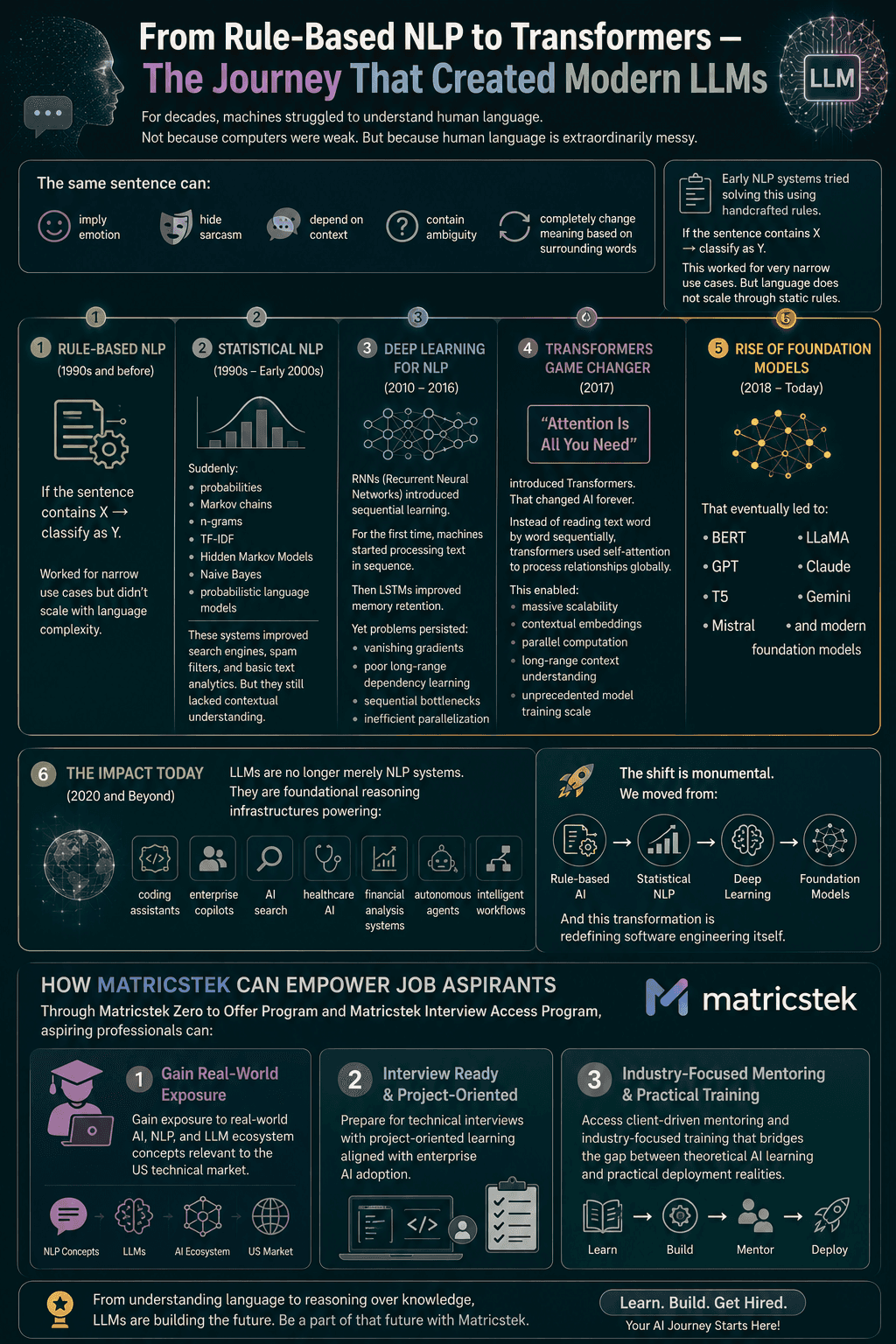
Not because computers were weak.But because human language is extraordinarily messy.
The same sentence can:
imply emotion,
hide sarcasm,
depend on context,
contain ambiguity,
and completely change meaning based on surrounding words.
Early NLP systems tried solving this using handcrafted rules.
If the sentence contains X → classify as Y.
This worked for very narrow use cases.
But language does not scale through static rules.
That led to statistical NLP.
Suddenly:
Markov chains,
n-grams,
TF-IDF,
Hidden Markov Models,
Naive Bayes,
and probabilistic language models
started dominating the field.
These systems improved search engines, spam filters, and basic text analytics.
But they still lacked contextual understanding.
Then came deep learning.
RNNs (Recurrent Neural Networks) introduced sequential learning.
For the first time, machines started processing text in sequence.
Then LSTMs improved memory retention.
Yet problems persisted:
vanishing gradients,
poor long-range dependency learning,
sequential bottlenecks,
inefficient parallelization.
Then 2017 happened.
The paper:
“Attention Is All You Need”
introduced Transformers.
That changed AI forever.
Instead of reading text word by word sequentially, transformers used self-attention to process relationships globally.
This enabled:
massive scalability,
contextual embeddings,
parallel computation,
long-range context understanding,
unprecedented model training scale.
That eventually led to:
BERT,
GPT,
T5,
LLaMA,
Claude,
Gemini,
Mistral,
and modern foundation models.
Today, LLMs are no longer merely NLP systems.
They are foundational reasoning infrastructures powering:
coding assistants,
enterprise copilots,
AI search,
healthcare AI,
financial analysis systems,
autonomous agents,
and intelligent workflows.
The shift is monumental.
We moved from:Rule-based AI → Statistical NLP → Deep Learning → Foundation Models.
And this transformation is redefining software engineering itself.
How Matricstek Can Empower Job Aspirants
Through Matricstek Zero to Offer Program and Matricstek Interview Access Program, aspiring professionals can:
Gain exposure to real-world AI, NLP, and LLM ecosystem concepts relevant to the US technical market.
Prepare for technical interviews with project-oriented learning aligned with enterprise AI adoption.
Access client-driven mentoring and industry-focused training that bridges the gap between theoretical AI learning and practical deployment realities.