
Rapid Elasticity in Cloud Computing: The Skill That Separates Modern Engineers from the Rest
In today�s digital economy, businesses don�t just compete on products�they compete on speed, scalability, and adaptability.
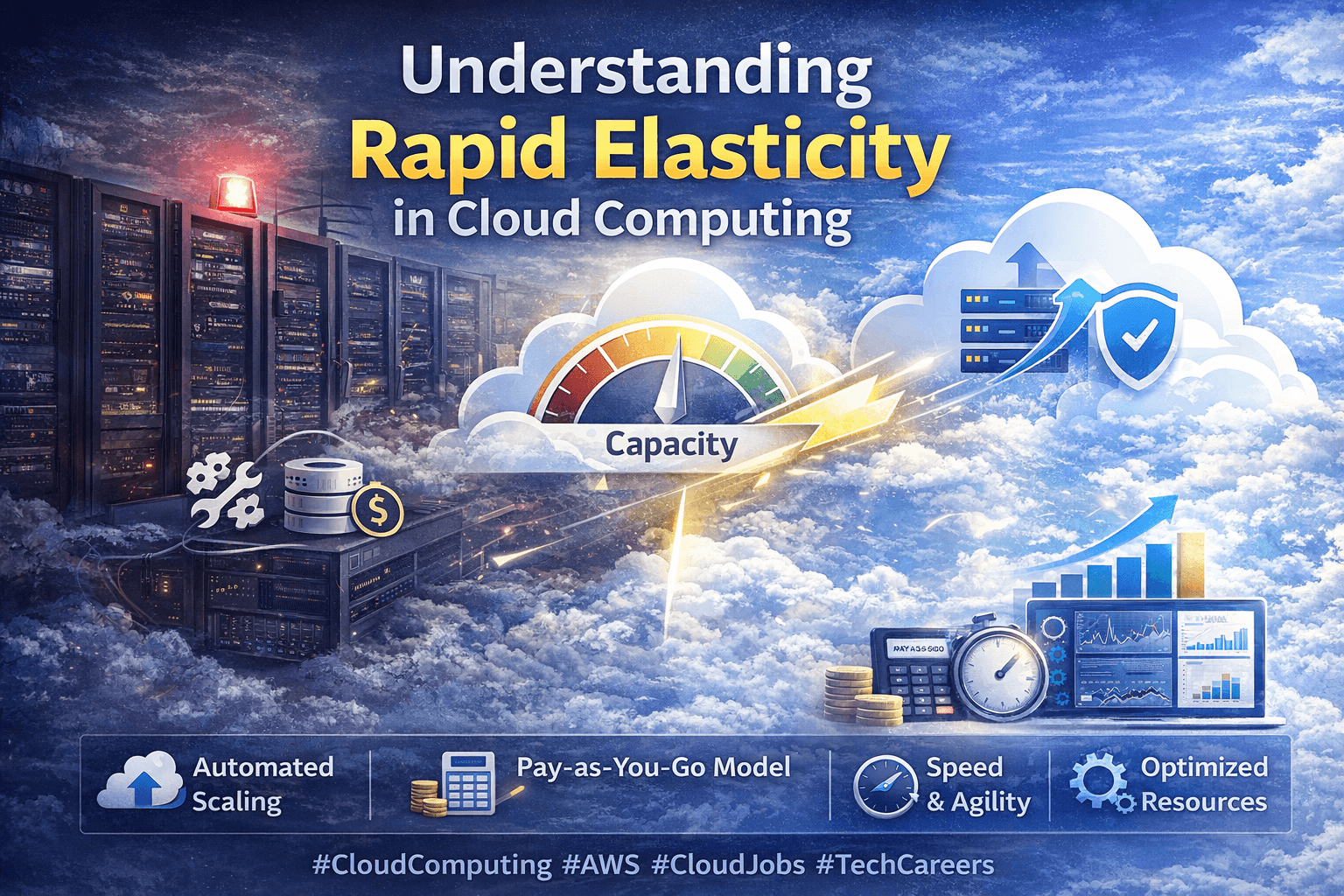
A sudden spike in users.
A viral product launch.
A seasonal surge like Black Friday.
The question is no longer �Will your system handle it?�
It is:
?? �Can your system scale instantly without breaking?�
This is where cloud computing introduces one of its most powerful capabilities: Rapid Elasticity.
And for professionals targeting cloud computing jobs in the USA, this is not just a concept�it�s a career-defining skill.
________________________________________
?? What is Rapid Elasticity?
Rapid elasticity is the ability of a cloud system to automatically scale computing resources up or down in real-time, based on demand.
Unlike traditional infrastructure, where scaling requires:
� Hardware procurement
� Manual configuration
� Significant downtime
Cloud platforms like AWS (Amazon Web Services) allow systems to dynamically adjust resources within seconds.
?? In simple terms:
Resources appear when you need them�and disappear when you don�t.
________________________________________
?? Traditional Infrastructure vs Cloud Elasticity
Let�s understand the contrast:
Traditional IT Approach:
� Capacity planning based on assumptions
� High upfront investment (CapEx)
� Over-provisioning to handle peak loads
� Idle resources during normal operations
� Slow and manual scaling
Cloud Computing Approach:
� Real-time scaling based on demand
� Pay-as-you-go (OpEx model)
� No idle infrastructure
� Automated provisioning
� High responsiveness
?? The shift is from static systems to adaptive systems.
________________________________________
?? Key Benefits of Rapid Elasticity for Businesses
________________________________________
?? 1. Eliminating Capacity Guesswork
In traditional setups, businesses must predict future demand and invest accordingly.
This often leads to:
� Overestimating ? Wasted resources
� Underestimating ? System failures
With rapid elasticity:
� Systems scale dynamically
� No need for long-term capacity assumptions
?? Businesses can stop guessing and start responding in real-time.
________________________________________
?? 2. Cost Efficiency with Pay-as-You-Go
Rapid elasticity works closely with the cloud�s measured service model.
Instead of:
� Investing heavily in infrastructure that may remain unused
Organizations:
� Pay only for the resources they actually consume
?? This makes cloud computing financially efficient, especially for startups and scaling enterprises.
________________________________________
? 3. Increased Speed and Agility
Traditional scaling is slow because it depends on physical infrastructure.
Cloud environments:
� Scale automatically within seconds
� Respond instantly to demand spikes
� Enable faster product rollouts
?? Speed is no longer a luxury�it�s a business necessity.
________________________________________
?? 4. Optimized Resource Utilization
On-premise systems are often inefficient because resources remain underutilized.
With rapid elasticity:
� Resources are allocated precisely when needed
� Released immediately after use
?? This ensures maximum efficiency with minimal waste.
________________________________________
?? 5. Supporting Global Scalability
Cloud platforms like AWS allow businesses to scale across:
� Multiple regions
� Multiple availability zones
This ensures:
� Consistent performance worldwide
� Seamless user experience across geographies
?? A critical capability for companies operating in global markets like the USA.
________________________________________
?? Why Rapid Elasticity Matters for Job Seekers in the USA
The demand for cloud professionals is growing rapidly across industries.
Roles such as:
� Cloud Engineer
� DevOps Engineer
� Data Engineer
� Site Reliability Engineer (SRE)
� Data Scientist
�are increasingly expected to have strong cloud computing expertise.
________________________________________
?? What Employers Are Really Looking For
If you�re targeting cloud computing jobs in the USA, employers expect more than just tool familiarity.
They want professionals who can:
?? Design systems that scale automatically
?? Optimize cost using elastic infrastructure
?? Handle traffic spikes without downtime
?? Build resilient, high-performance architectures
?? Leverage AWS services for dynamic scaling
________________________________________
?? The Role of Rapid Elasticity in Data Science
A crucial but often overlooked insight:
?? Modern data science training must include cloud concepts.
Why?
� Data pipelines often face fluctuating workloads
� Machine learning models require scalable compute power
� Real-time analytics demands dynamic resource allocation
Cloud services like:
� AWS EC2 (compute scaling)
� AWS S3 (scalable storage)
� AWS Lambda (serverless execution)
� AWS Auto Scaling (dynamic resource management)
�are integral to modern data science workflows.
?? Without understanding rapid elasticity, a data professional�s skillset remains incomplete.
________________________________________
?? From Learning Tools to Designing Systems
At MatricsTek Inc., we emphasize a critical mindset shift:
? Learning isolated tools
? Designing scalable, adaptive systems
Because in real-world scenarios:
� Demand is unpredictable
� Failures are inevitable
� Performance expectations are high
?? The real skill lies in how systems behave under changing conditions.
________________________________________
?? How to Build Expertise in Rapid Elasticity
If you want to stay relevant in today�s job market:
?? Focus Areas:
� AWS Auto Scaling and Elastic Load Balancing
� Serverless architectures (AWS Lambda)
� Infrastructure as Code (Terraform, CloudFormation)
� Monitoring and scaling policies
� Cost optimization strategies
________________________________________
??? Practical Learning Approach:
� Build projects that simulate traffic spikes
� Implement auto-scaling groups
� Analyze system performance under load
� Optimize resource allocation
?? Hands-on experience is what differentiates candidates in interviews.
________________________________________
?? Final Thoughts
Rapid elasticity is not just a feature of cloud computing�
it�s a fundamental shift in how systems are designed and operated.
For businesses, it means:
?? Flexibility
?? Cost efficiency
?? Speed
For professionals, it means:
?? Relevance in a cloud-first job market
________________________________________
The real question is no longer:
? �Can your system handle growth?�
But:
? �Can your system scale intelligently, instantly, and efficiently?�
________________________________________
At MatricsTek Inc., we help aspiring professionals bridge the gap between learning and real-world expectations, ensuring they are prepared for high-demand cloud computing jobs in the USA.
________________________________________
?? Are you still thinking in fixed capacity� or building systems that scale with demand?
________________________________________
?? Keywords:
cloud computing, rapid elasticity, AWS, cloud computing jobs in USA, data science training, cloud architecture, auto scaling, DevOps, SRE, scalable systems, digital transformation