
Tokenization, Embeddings, and Attention — The Building Blocks of LLMs
At the heart of every LLM lies a deceptively simple objective:
Predict the next token.
But behind that simplicity exists one of the most sophisticated engineering systems ever built.
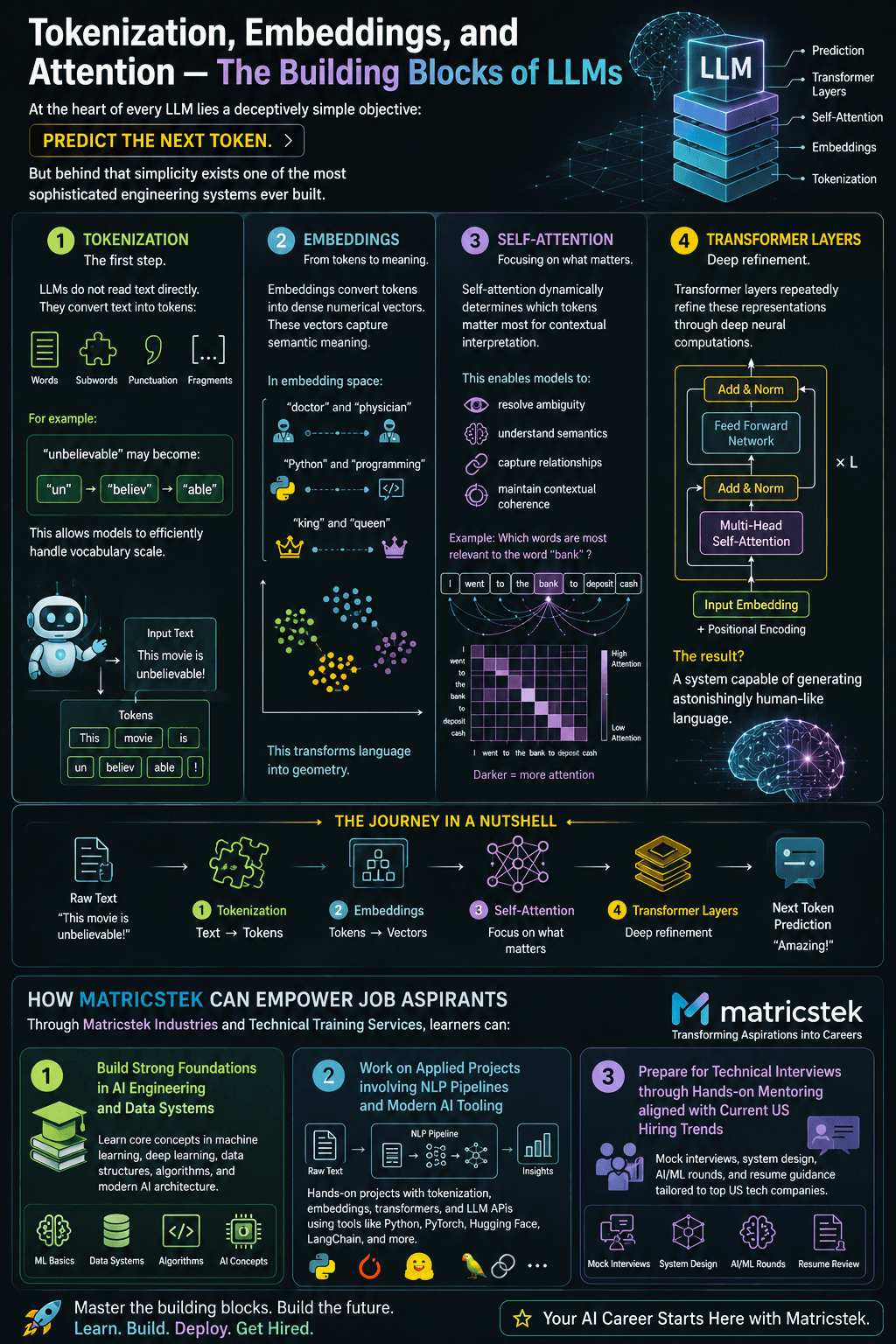
The first step is tokenization.
LLMs do not read text directly.
They convert text into tokens:
or fragments.
For example:“unbelievable” may become:
“un”
“believ”
“able”
This allows models to efficiently handle vocabulary scale.
Next comes embeddings.
Embeddings convert tokens into dense numerical vectors.
These vectors capture semantic meaning.
In embedding space:
“doctor” and “physician”
“Python” and “programming”
“king” and “queen”
exist in related regions.
This transforms language into geometry.
Then comes self-attention.
Self-attention dynamically determines which tokens matter most for contextual interpretation.
This enables models to:
resolve ambiguity,
understand semantics,
capture relationships,
and maintain contextual coherence.
Finally, transformer layers repeatedly refine these representations through deep neural computations.
The result?
A system capable of generating astonishingly human-like language.
How Matricstek Can Empower Job Aspirants
Through Matricstek Industries and Technical Training Services, learners can:
Build strong foundations in AI engineering and data systems.
Work on applied projects involving NLP pipelines and modern AI tooling.
Prepare for technical interviews through hands-on mentoring aligned with current US hiring trends.